Razor Robotics, dedicated to robot education Robot working at a computer
 Contact us   About us   Help   
          
     
    Quick Links
    State of the Art Robots
    State of the Art Robots

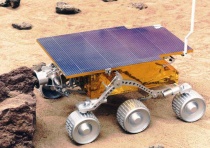
    Mars Rover - Sojourner
    Robots in Space

    Future of Robotics
    Future of Robotics

    Robots in Space

      This page is still under construction.  More content coming soon!
    Share |

    Since the launch of the first satellite Sputnik 1 in 1957, robots have been used used to explore space. These Early space machines, although cutting-edge at the time, were mainly remote-controlled and had little to no autonomy. Todays robots are very different to these early machines, computing power and circuit miniaturisation has allowed designers to create robots capable of doing useful tasks in space that previously we could only have imagined doing.
        The following sections present a number of important space missions and show how robotics is being used.


    Robonaut2 (Robot Astronaut)

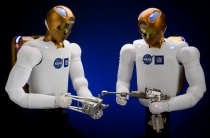
    Robonaut2, or R2 for short, is the next generation dexterous robot, developed through a Space Act Agreement by NASA and General Motors. It is faster, more dexterous and more technologically advanced than its predecessors and able to use its hands to do work beyond the scope of previously introduced humanoid robots.

    Robonaut2 surpasses previous dexterous humanoid robots in strength, yet it is safe enough to work side-by-side with humans. It is able to lift, not just hold, this 20-pound weight (about four times heavier than what other dexterous robots can handle) both near and away from its body.

    The following video shows the latest development in space robotics; the humanoid robot astronaut (Robonaut) developed by NASA and GM:


    General Motors and NASA introduce Robonaut2


    The idea of using dexterous, human-like robots capable of using their hands to do intricate work is not new to the aerospace industry. The original Robonaut, a humanoid robot designed for space travel, was built by the software, robotics and simulation division at Johnson in a
    Robonaut 2Robonaut 2 cooperatively using tools - © 2010 NASA
    collaborative effort with the Defence Advanced Research Project Agency 10 years ago. During the past decade, NASA gained significant expertise in building robotic technologies for space applications. These capabilities will help NASA launch a bold new era of space exploration.

    "Our challenge today is to build machines that can help humans work and explore in space," said Mike Coats, Johnson's center director. "Working side by side with humans, or going where the risks are too great for people, machines like Robonaut will expand our capability for construction and discovery." (http://robonaut.jsc.nasa.gov/).


    Mars Exploration Rover Mission

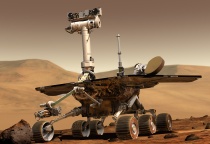
    NASA's Mars Exploration Rover Mission (MER), is an ongoing robotic space mission involving two rovers, Spirit and Opportunity, exploring the planet Mars. It began in 2003 with the sending of the two rovers — MER-A Spirit and MER-B Opportunity — to explore the Martian surface and geology. The Mars Rover Spirit landed on the Martian surface on the 4th January 2004 and Opportunity on the 25th January 2004, since then the rovers have continually send back data about the red planet.

    On May 1, 2009 (5 years, 3 months, 27 Earth days after landing; 21.6 times the planned mission duration), the Rover Spirit became stuck in soft soil and after months of trying to manoeuvre free of the hazard, Scientists decided to turn the Rover into a stationary observation platform.
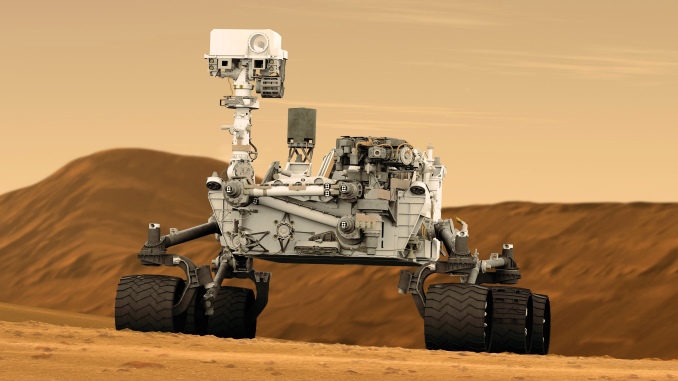
    Mars Exploration RoverAn artist's concept of NASA's Mars Exploration Rover on the
    surface of Mars. Two rovers have been built for 2003
    launches and January 2004 arrival at two sites on Mars.
    Each rover has the mobility and toolkit to function as a
    robotic geologist.


    Each rover is made up of a panoramic camera at human-eye height, and a miniature thermal emission spectrometer, with infrared vision, which help scientists identify the most interesting rocks. The rovers can watch for hazards in their way and manoeuvre around them. Each six-wheeled robot has a deck of solar panels, about the size of a kitchen table, for power. The rover drives to the selected rock and extends an arm with tools on the end. Then, a microscopic imager, like a geologist's hand lens, gives a close-up view of the rock's texture. Two spectrometers identify the composition of the rock. The fourth tool substitutes for a geologist's hammer. It exposes the fresh interior of a rock by scraping away the weathered surface layer.

    The Mars Exploration Rover mission seeks to determine the history of climate and water at sites on Mars where conditions may once have been favourable to life. Each rover is equipped with a suite of science instruments that will be used to read the geologic record at each site, to investigate what role water played there, and to determine how suitable the conditions would have been for life.


    Mars Exploration Rover Mission: Quick Facts


    The following lists a few key facts of the equipment used to deliver the Rovers, Spirit and Opportunity, to the surface of Mars.

    Spacecraft
    • Cruise vehicle dimensions: 2.65 meters (8.7 feet) diameter, 1.6 meters (5.2 feet) tall
    • Rover dimensions: 1.5 meter (4.9 feet) high by 2.3 meters (7.5 feet) wide by 1.6 meter (5.2 feet) long
    • Weight: 1,062 kilograms (2,341 pounds) total at launch, consisting of 174-kilogram (384- pound) rover, 365-kilogram (805-pound) lander, 198-kilogram (436-pound) backshell and parachute, 90-kilogram (198-pound) heat shield and 183-kilogram (403-pound) cruise stage, plus 52 kilograms (115 pounds) of propellant
    • Power: Solar panel and lithium-ion battery system providing 140 watts on Mars surface
    • Science instruments: Panoramic cameras, miniature thermal emission spectrometer, Mössbauer spectrometer, alpha particle X-ray spectrometer, microscopic imager, rock abrasion tool, magnet arrays

    Rover A Mission (Spirit)
    • Launch vehicle: Delta II 7925
    • Launch period: June 8-24, 2003
    • Earth-Mars distance at launch: 105 million kilometers (65 million miles)
    • Mars landing: Jan. 4, 2004, at about 2 p.m. local Mars time (8:11 p.m. Jan. 3 PST)
    • Landing site: Gusev Crater, possible former lake in giant impact crater
    • Earth-Mars distance on landing day: 170.2 million kilometers (105.7 million miles)
    • One-way speed-of-light time Mars-to-Earth on landing day: 9.46 minutes
    • Total distance traveled Earth to Mars (approximate): 500 million kilometers (311 million miles)
    • Near-surface atmospheric temperature at landing site: -100 C (-148 F) to 0 C (32 F)
    • Primary mission: 90 Mars days, or "sols" (equivalent to 92 Earth days)

    Rover B Mission (Opportunity)
    • Launch vehicle: Delta II 7925H (larger solid-fuel boosters than 7925)
    • Launch period: June 25-July 15, 2003
    • Earth-Mars distance at launch: 89 million kilometers (55 million miles)
    • Mars landing: Jan. 25, 2004, at about 1:15 p.m. local Mars time (8:56 p.m. Jan. 24 PST)
    • Landing site: Meridiani Planum, where mineral deposits suggest wet past
    • Landing time: Approximately 1:15 p.m. local Mars time (8:56 p.m. PST)
    • Earth-Mars distance on landing day: 198.7 million kilometers (123.5 million miles)
    • One-way speed-of-light time Mars-to-Earth on landing day: 11 minutes
    • Total distance traveled Earth to Mars (approximate): 491 million kilometers (305 million miles)
    • Near-surface atmospheric temperature at landing site: -100 C (-148 F) to 0 C (32 F)
    • Primary mission: 90 Mars days, or "sols" (equivalent to 92 Earth days)
    Program
    • Cost: Approximately $800 million total, consisting approximately of $625 million spacecraft development and science instruments; $100 million launch; $75 million mission operations and science processing


    Latest Discussions
    Follow us on Twitter
    Featured Article
    What's New
    Free Downloads: Teaching Resources & Beginner Guides

    Privacy Policy | Terms & Conditions | Contact us | Feedback
    Razor Robotics Logo
    © 2011 RazorRobotics.com. All rights reserved.