This page looks at the latest Robots being developed around the world. To help you find what you are looking for, please click one of the links above to filter the Robot articles.
In 1986, Honda engineers set out to create a walking robot. Early models (E1, E2, E3) focused on developing legs that could simulate the walk of a human. The next series of models (E4, E5, E6) were focused on walk stabilisation and stair climbing. Next, a head, body and arms were added to the robot to improve balance and add functionality. Honda’s first humanoid robot, P1 was rather rugged at 6’ 2" tall, and 386 lbs. P2 improved with a more friendly design, improved walking, stair climbing/descending, and wireless automatic movements. The P3 model was even more compact, standing 5’ 2" tall and weighing 287 lbs.
The Present
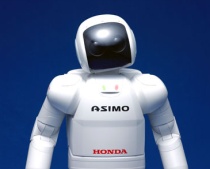
ASIMO, which stands for Advanced Step in Innovative Mobility, is the culmination of two decades of humanoid robotics research by Honda engineers. ASIMO can run, walk on uneven slopes and surfaces, turn smoothly, climb stairs, and reach for and grasp objects. ASIMO can also comprehend and respond to simple voice commands. ASIMO has the ability to
recognise the face of a select group of individuals. Using its camera eyes, ASIMO can map its environment and register stationary objects. ASIMO can also avoid moving obstacles as it moves through its environment.
The Future
While development continues on ASIMO, Honda is demonstrating ASIMO around the world to encourage and inspire young students to study the sciences. And in the future, ASIMO may serve as another set of eyes, ears, hands and legs for all kinds of people in need. Someday ASIMO might help with important tasks like assisting the elderly or a person confined to a bed or a wheelchair. ASIMO might also perform certain tasks that are dangerous to humans, such as fighting fires or cleaning up toxic spills.
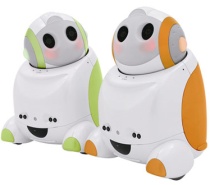
PaPeRo is a personal Robot being developed by NEC Corporation. The small size and colourful design of PaPeRo is intended to appeal to both children and adults, with its face designed to look both friendly and nonthreatening.
Development began in 1997 with the first prototype R100, and in 2001 the name PaPeRo, which stands for "Partner-type-Personal-Robot" was adopted.
PaPeRo Specification:
Communication:
Human language can be recognised using speech recognition technology. Basically PaPeRo recognise approximately 200 words and it will increase accordingly when new functions are incorporated to PaPeRo.
PaPeRo uses latest speech synthesis technology and it can speak with natural and cute voice. When the surroundings are noisy or the sounds spoken to the PaPeRo are too loud or too soft, this is recognised and communicated to the user.
With built-in face detection, PaPeRo can locate people from the images on its CCD camera by means of image recognition technology. The facial identification system can discriminate among and memorise the faces of up to 30 people.
By tracking a face that it has found, it can interact while always looking at the face. When it cannot see a face well or if the distance or location is not satisfactory, it will adjust the distance on its own or tell the person, "It's too dark".
React to Touch:
Nine touch sensors are mounted on the head and the body of the robot to achieve various interaction with children from a wide range of ages, including infants. For example, PaPeRo become happy when you pet its head and PaPeRo tickles when you touch its belly.
Autonomous Behaviour:
When PaPeRo is not talking with people it engages in autonomous activities such as walking around the room at will or dancing on its own. Using its sensors such as cameras and ultrasonic sensors, PaPeRo can walk without colliding with objects on the floor.
Self-charging:
When PaPeRo's battery level drops, it look for its charging station and it docks from its back by itself. When its battery is charged, PaPeRo comes out from the charging station.
Partner is a series of Robots being developed by Toyota. As the table below shows the Partner Robots come in three forms: Walking, Rolling and Mountable. Toyota are pitching their Partner Robot as a 'Personal Assistance' Robot, and by having three diverse types of Robot, they are able to compete with their main rival, namely Honda's Asimo, in areas that ASIMO is not capable of functioning.
A recent press release from Toyota states, "Toyota wants its partner robots to have human characteristics, such as being agile, warm and kind and also intelligent enough to skillfully operate a variety of devices in the areas of personal assistance, care for the elderly, manufacturing, and mobility. Furthermore, since each area requires a special set of skills, Toyota is promoting the development of three different types of partner robots (walking, rolling, and mountable), each with its own areas of expertise." (www.toyota.co.jp/en/news/04/0311.html)
Overview of the Partner Robots
Type
Walking
Rolling
Mountable
Main Areas of Application
Assistance, elderly care
Manufacturing, mobility
Elderly care, mobility
Features
The walking model walks on two legs similar to a person, making it easy to become accustomed to. It is able to use its hands to carry out a wide variety of tasks.
The rolling model zooms along quickly without taking up much space. It is able to use its hands to carry out a wide variety of tasks.
The mountable model is capable of carrying its passengers almost anywhere they need to go. It is fun to ride and operate.
RT-1 is a self contained, fully automated Robotic Torso, designed and built by Elumotion to provide a robotic platform based on human anatomy. RT-1 is a highly articulated manipulating platform and includes novel dexterous hands that allow emulation of human gesturing.
This first generation humanoid was realised through a collaboration between Elumotion Ltd, providing the robotic torso hardware, and Bristol Robotics Laboratory (BRL), providing the high level control. RT-1 represents an early stage in the exploration of human-robot interaction. BRL (Bristol Robotics Laboratory) are using the original RT-1 in their research to develop Robot controlled strategies that aim to replicate aspects of human gesturing.
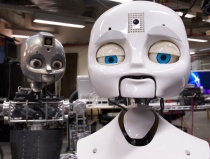
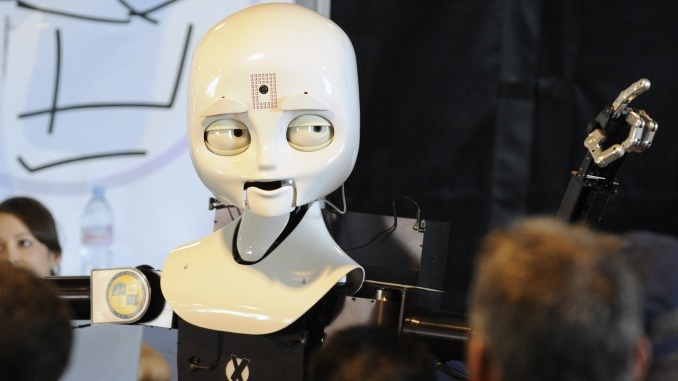
MIT has announced that it is developing a new expressive robot named Nexi. Nexi is designed to convey human emotions though facial movements, such as slanting eyebrows and head-movements. The Nexi robot has been designed by Xitome Design in collaboration with MIT and has been refereed to by MIT as a "MDS" class of robot this being short for 'Mobile/Dexterous/Social'.
MIT have stated that "The purpose of this platform is to support research and education goals in human-robot interaction, teaming, and social learning. In particular, the small footprint of the robot (roughly the size of a 3 year old child) allows multiple robots to operate safely within a typical laboratory floor space. MIT is responsible for the overall design, the mobile manipulator is developed by UMASS Amherst, and system integration is handled by Xitome Design." (robotic.media.mit.edu/projects/robots/mds/overview/overview.html)
Nexi is equipped with a color CCD camera in each eye, an active 3D infrared camera in its head and four microphones. The neck mechanism has 4
DoFs to support a lower bending at the base of the neck as well as pan-tilt-yaw of the head. The head can move at human-like speeds to support
human head gestures such as nodding, shaking, and orienting. The Nexi head is attached to a base comprised of two manipulating arms with gripping hands and two wheels. The wheels are much like a Segway and using a microprocessor the robot is capable of self-balancing.
MIT has a history of research with expressive robots; Kismet, developed in the late 1990s, was one of the first robots designed to mimic human facial emotions.
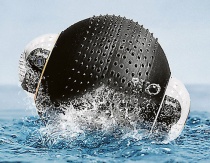
GroundBot is a self-contained autonomous Robot developed by Rotundus. GroundBot has been designed as a sealed unit with no external moving parts. Instead an internal gyroscopic weight is used to propel the Robot forward, as shown in the adjacent diagram.
GroundBot has been designed for use in harsh environments, where traditional wheeled or tracked Robots may not function properly. These environments include: investigating gas leaks, interplanetary expeditions and locating earthquake survivors. The Robot can operate in most terrains including deep snow, ice, mud and sand.
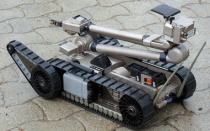
PackBot is a series of small tracked robots developed for the Military by the iRobot Corporation. According to iRobot, More than 3,000 PackBot robots have been delivered worldwide. (www.irobot.com/sp.cfm?pageid=171).
PackBot has been designed to easily climbs stairs, rolls over rubble and navigates narrow, twisting passages. The robot’s patented mobility platform features dual QuickFlip™ track articulations. These 'flippers' are capable of continuous 360-degree rotation and enable PackBot to traverse rocks, mud, snow, gravel and other tough terrain. PackBot’s flexible polymer tracks eject debris and move the robot over all surfaces with sure-footed efficiency. PackBot even climbs grades up to 60 degrees. PackBot 510 is 30 percent faster, capable of travelling at speeds of up to 5.8 miles per hour (9.3 km/h).
PackBot’s shock-resistant chassis can survive shocks of up to 400 Gs. This tough robot can withstand a six-foot drop (1.8 m) onto concrete, being thrown through a window, tumbling down stairs and being deployed from a low-altitude helicopter. PackBot is fully sealed, with no exposed wires, making the robot operational in all weather conditions. PackBot can also withstand submersion in 6 feet (1.8 m) of water.
PackBot offers multi-mission flexibility and customisation options on a proven chassis. State-of-the-art electronics enhance payload integration capabilities. Each of the eight payload ports is equipped with Ethernet, USB, power and two video channels. As a result, there is no limit to the types of payloads the robot can support. Interchangeable, modular payloads enable the robot to perform a wide variety of missions.
PackBot can be hand carried and deployed by one person in less than two minutes. No expensive, specialised equipment or vehicles are necessary; PackBot can be easily loaded into a MOLLE pack, the trunk of a car or a helicopter. Once deployed, the robot can quickly penetrate collapsed buildings, sewers, tunnels, airplane aisles, railroad cars and other areas that are inaccessible or dangerous.
The robot relays real-time video, audio and other sensor readings while the operator stays at a safe standoff distance. The operator can view a 2-D or 3-D image of the robot on the control unit, allowing for precise positioning. The control unit is battery-powered and can also be used with a supplementary power supply. PackBot 510 also features a game-style hand controller for faster training and easier operation in the field.
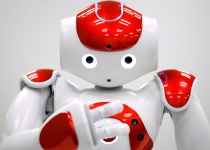
Nao (pronounced "now") is a medium-sized humanoid autonomous robot, developed by Aldebaran Robotics.
Nao has four microphones fitted into his head and a voice recognition and analysis system. He recognises a set of predefined words that you can supplement with your own expressions. These words trigger any behaviour you choose. Available so far in English and French, we are working on adding six other languages (Dutch, German, Italian, Spanish, Mandarin and Korean).
Nao is also capable of detecting the source of a sound or voice to deal with that source and start interacting.
Nao can express himself by reading out any file stored locally in his storage space or captured from a web site of RSS flow. Fitted with two speakers placed on either side of the head, his vocal synthesis system can be configured, allowing for voice alterations such as speed or tone. He is available in French and English and we are currently developing other languages for this vocal synthesis in the meantime.
Naturally, you can send a music file to Nao and have him play it. He accepts _.wav and _.mp3 formats, which allows you to punctuate your behaviours with music or personalised sounds.
Nao sees by means of two CMOS 640 x 480 cameras, which can capture up to 30 images per second.
The first is on the forehead, aimed at Nao’s horizon, while the second camera is placed at mouth level to scan the immediate environment. The software lets you recover photos that Nao sees and video streams.
Yet what use are eyes, unless you can also perceive and interpret your surroundings? That’s why Nao contains a set of algorithms to detect and recognise faces and shapes, so he can recognise the person talking to him, find a ball, and ultimately much more complex objects. These algorithms have been specially developed, with constant care taken to use up minimum processor resources.
Furthermore, Nao’s SDK lets you develop your own modules interfaced with OpenCV (the Open Source Computer Vision library initially developed by Intel). As you have the option to execute modules on Nao or transfer them to another PC connected to NAO, you can easily use the OpenCV display functions to develop and test your own algorithms with image feedback.
Nao is fitted with a capacitive sensor placed on the top of his head, divided into three sections. You can therefore give Nao information through touch: pressing once to tell him to turn off, for example, or using this sensor as a series of buttons to trigger an associated action. The system comes with LED, indicating the type of contact. It is also possible to program complex sequences.
Nao can communicate in several ways. For local connections, infrared senders/receivers placed in his eyes allow him to connect to the objects in his environment, serving as a remote control. Yet Nao can also logon to your local network via Wi-Fi, making it easy to pilot and program him through a computer, or any other object that has a Wi-Fi connection. The Wi-Fi key is connected to the mother board and accepts a, b and g standards.
Besides local communication, Nao can browse the Internet, of course, and interface with any website to send or retrieve data.
they can talk to each other and work together. You can choose to connect them directly in Wi-Fi, infrared or even body language. This really facilitates research possibilities on collaborative work between robots and means that several Nao can perform complex tasks such as geographic positioning or pooling analytical capacity.
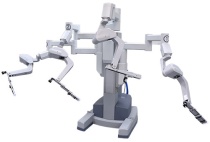
The da Vinci Surgical System, developed by Intuitive Surgical, is a sophisticated robotic platform designed to enable complex
surgery using a minimally invasive approach. The da Vinci System consists of an ergonomic
surgeon’s console, a patient-side cart with four interactive robotic arms, a high-performance 3D
HD vision system and proprietary EndoWrist® instruments. Powered by state-of-the-art robotic
technology, the da Vinci System is designed to scale, filter and seamlessly translate the surgeon's
hand movements into more precise movements of the EndoWrist instruments. The net result is an
intuitive interface with breakthrough surgical capabilities.
The da Vinci Surgical System’s main features include Intuitive® motion, high-resolution 3D vision
and innovative EndoWrist instrumentation. Intuitive motion refers to the System’s interface,
which helps make da Vinci surgery look and feel like traditional "open" surgery. But this is where
the similarities end.
The da Vinci System’s high-resolution 3D stereo viewer is designed to provide surgeons with an
immersive experience. Unlike conventional approaches, the target anatomy appears at high
magnification, in brilliant color and with natural depth of field. To perform a procedure, the surgeon
uses the console’s master controls to manoeuvre the patient-side cart’s four robotic arms, which
securely hold the patented EndoWrist instruments and high-resolution endoscopic camera. The
EndoWrist instruments’ jointed-wrist design exceeds the natural range of motion of the human hand;
motion scaling and tremor reduction further interpret and refine the surgeon’s hand movements. A final
hallmark of the da Vinci System is its fail-safe design, incorporating multiple, redundant safety features
designed to minimise opportunities for human error when compared with traditional approaches.
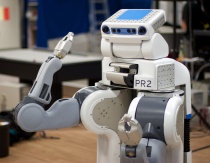
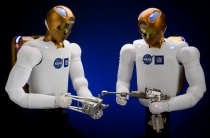
NASA and General Motors have joined forces to develop a new version of NASA's humanoid robot astronaut. Robonaut-2 or R2, was first demonstrated to the public on 4th February 2010. The aim of the Robonaut project is to investigate technologies that can be used in space exploration to help and improve safety for astronauts.
Robonaut-2 is a humanoid robot comprised of a torso, two dexterous manipulating arms and a head fitted with a vision system. Each arm is capable of lifting 20lb weights, which can moved away from the robot while maintaining balance...read more
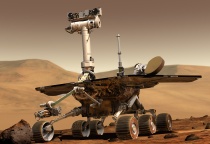
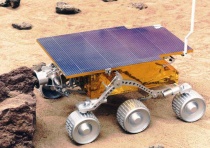
An artist's concept of NASA's Mars Exploration Rover on the surface of Mars.
NASA's Mars Exploration Rover Mission (MER), is an ongoing robotic space mission involving two rovers, Spirit and Opportunity, exploring the planet Mars. It began in 2003 with the sending of the two rovers — MER-A Spirit and MER-B Opportunity — to explore the Martian surface and geology. The Mars Rover Spirit landed on the Martian surface on the 4th January 2004 and Opportunity on the 25th January 2004, since then the rovers have continually send back data about the red planet.
Each rover is made up of a panoramic camera at human-eye height, and a miniature thermal emission spectrometer, with infrared vision, which help scientists identify the most interesting rocks. The rovers can watch for hazards in their way and manoeuvre around them. Each six-wheeled robot has a deck of solar panels, about the size of a kitchen table, for power. The rover drives to the selected rock and extends an arm with tools on the end. Then, a microscopic imager, like a geologist's hand lens, gives a close-up view of the rock's texture. Two spectrometers identify the composition of the rock. The fourth tool substitutes for a geologist's hammer. It exposes the fresh interior of a rock by scraping away the weathered surface layer...read more
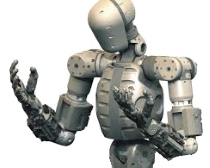
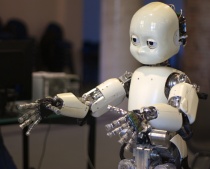
The iCub, 'Cub' standing for Cognitive Universal Body, is a 53 degree-of-freedom humanoid robot of the same size as a three and a
half year-old child. It can crawl on all fours and sit up. Its hands allow dexterous manipulation
and its head and eyes are fully articulated. It has visual, vestibular, auditory, and haptic sensory
capabilities.
The iCub is being developed as part of the RobotCub Project. The RobotCub project is an Integrated Project funded by European
Commission through its Cognitive Systems and Robotics Unit. The project was launched on the 1st of September 2004 and will run
for a total of 60 months. The consortium is composed of 10 European research centres and is complemented by three research centres
in the USA and three in Japan, all specialists in robotics, neuroscience, and developmental psychology.
As part of the RobotCub Consortium aggreement, the iCub has been developed as an open systems platform. Users and developers
in all disciplines, from psychology, through cognitive neuroscience, to developmental robotics, can use it and customize
it freely under a GPL license. It is intended to become the research platform of choice, so that
people can exploit it quickly and easily, share results, and benefit from the work of other users.
It is believed that this will lead to significantly greater community-wide progress in embodied cognition research.
It is intended that the iCub will develop its cognitive capabilities in the same way as a child, progressively learning
about its own bodily skills, now to interact with the world, and eventually how to communicate
with other individuals...read more